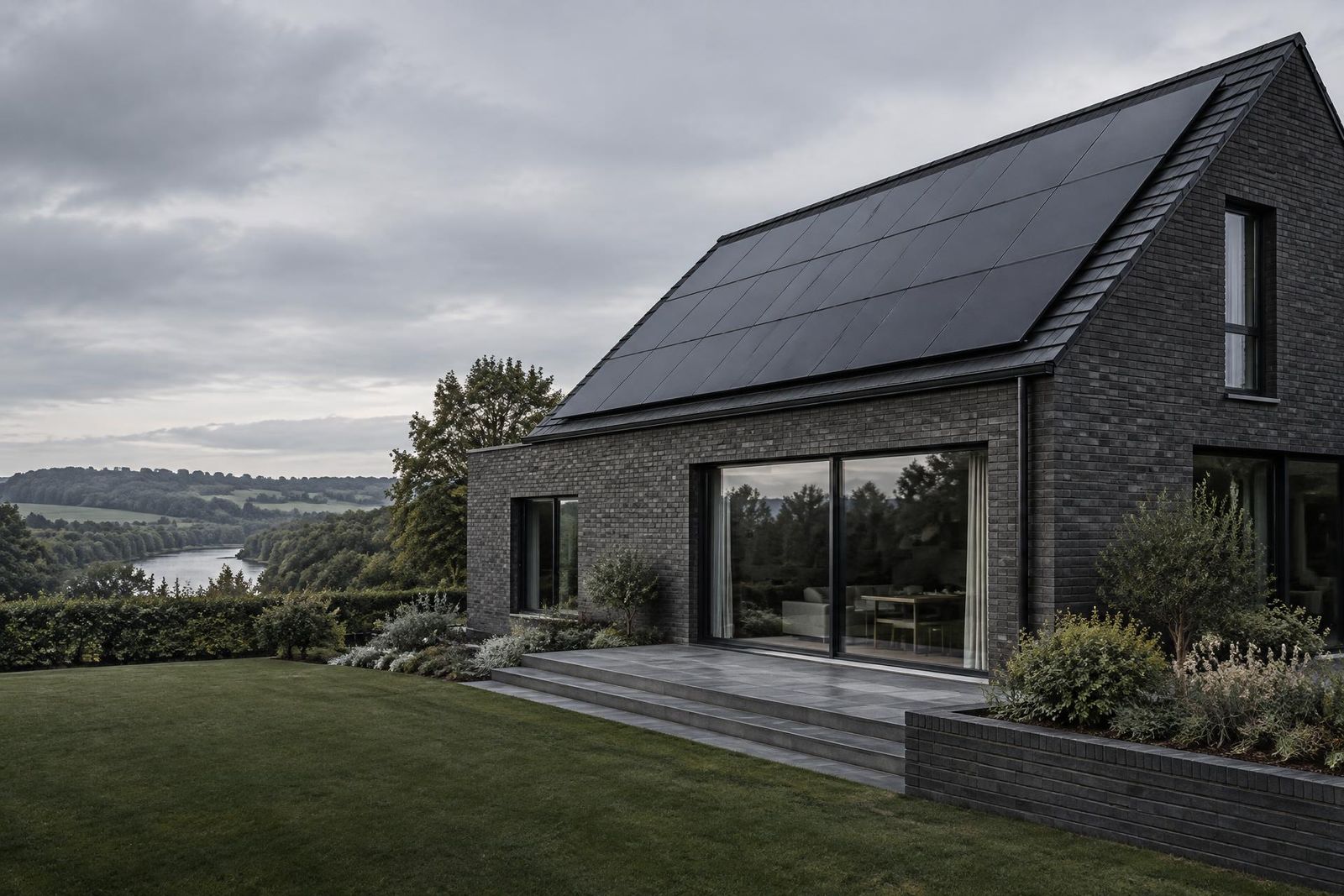
Southern England gets roughly 950–1,050 kWh per installed kWp of solar each year. That number, your roof, and how much electricity you actually use in daylight decide whether solar pays — everything else is detail. This guide gives the real figures we design to, how batteries change the maths, what a system costs in 2026, and the questions that separate a good quote from a bad one.
Roof orientation matters less than people think
A due-south pitch at around 35 degrees is the best case. But east–west arrays lose only around 15% of annual yield and spread generation across the morning and evening, which often suits a working household better than a midday peak they are not home to use.
Shading is the real problem. A single chimney, dormer or tree shadow across one panel can drag a whole string down unless the system uses optimisers or microinverters. That is why we design most Chilterns roofs — with their mature trees and complex rooflines — around per-panel electronics rather than a single string inverter.
| Orientation | Approx. annual yield | Relative to south |
|---|---|---|
| South | ~3,900 kWh | 100% |
| South-east / south-west | ~3,700 kWh | 95% |
| East / west (split array) | ~3,300 kWh | 85% |
| North | ~2,400 kWh | 62% — rarely worth it |
Sizing the array to the household, not the roof
The instinct is to fill the roof. Sometimes that is right — panel prices have fallen far enough that the marginal cost per extra panel is small — but only if you can use or profitably export the generation.
We start from your annual consumption in kWh, taken from a real bill rather than an estimate, then look at when you use it. A household at home during the day, or one with an EV, heat pump or hot water diverter, converts far more generation into savings than a house that is empty until seven.
In short
- Typical 4kWp array: around 3,700–4,000 kWh a year
- Self-consumption without a battery: roughly 35–50%
- With a right-sized battery: often 75%+
- A hot water diverter soaks up surplus cheaply before you add battery capacity
Sizing the battery honestly
Batteries do not make solar cheaper; they make more of it useful. The right size is roughly your evening and overnight consumption, not the biggest unit on the price list. Oversize it and you pay for capacity that sits empty for eight months of the year.
For most four-bedroom homes we specify 5–10 kWh. Bigger only makes genuine sense if you charge an EV at home, run a heat pump, or want to arbitrage a cheap overnight import tariff by filling the battery at night and using it through the day.
That last point is increasingly the strongest financial case. With a time-of-use tariff, a battery earns money in winter as well as summer, which shortens payback considerably compared with a solar-only system.
| Household | Annual use | Suggested capacity |
|---|---|---|
| Couple, 2-bed, out weekdays | 2,000–2,800 kWh | 5 kWh |
| Family, 3–4 bed | 3,000–4,500 kWh | 8–10 kWh |
| Family plus EV | 5,000–7,000 kWh | 10–15 kWh |
| EV plus heat pump | 8,000 kWh+ | 15 kWh+, often two units |

Export tariffs and what your surplus is really worth
Under the Smart Export Guarantee every relevant supplier must offer a rate for exported units, but rates vary widely and are not tied to your import supplier. Some fixed offers are modest; some flexible ones pay much more at peak times.
The important principle does not change: a unit you use yourself is worth what you would have paid to import it, which is almost always more than the export rate. That is why self-consumption, not raw generation, is the number worth optimising.
You need a smart meter capable of half-hourly export readings and an MCS certificate to register. We handle the DNO application and hand you the MCS paperwork you will need for the export application.
Get a shading survey and a fixed-price design for your roof.
What a system costs in 2026
A typical solar and battery installation starts at £6,500 including panels, inverter, mounting, protective devices, commissioning and DNO notification. Domestic solar and battery storage remains zero-rated for VAT, including batteries retrofitted to an existing array.
Payback in this region generally lands between eight and twelve years for solar plus battery, and shorter for solar alone with high daytime use. It shortens considerably if you charge an EV at home or use the battery on a time-of-use tariff.
| System | Guide price | Typical annual generation |
|---|---|---|
| 4kWp solar only | from £5,200 | ~3,800 kWh |
| 4kWp + 5kWh battery | from £6,500 | ~3,800 kWh, ~75% self-used |
| 6kWp + 10kWh battery | from £9,800 | ~5,700 kWh |
| Battery retrofit to existing array | from £3,400 | n/a — AC coupled |
Is your roof actually suitable?
Most are. The things that genuinely rule a roof out, or add cost, are structural rather than solar-specific: fragile or delaminating tiles, a roof due for replacement within a few years, or timbers that cannot take the additional load without strengthening.
Older clay and slate roofs across the Chilterns and Thames valley are usually fine, but need the right hook and flashing detail rather than a generic kit. We survey the loft as well as the roof surface before quoting.
In short
- Roof covering condition and expected remaining life
- Rafter size, spacing and any spread or sag
- Shading from chimneys, dormers, aerials and trees across the day
- Scaffolding access and any listed or conservation constraints
- Somewhere sensible and ventilated for the inverter and battery
Questions to ask any installer
Ask for the projected annual yield with the shading survey attached, not a generic figure. Ask for the inverter and battery warranty terms in years and cycles, who handles the DNO and export applications, and whether the quote includes scaffolding and any roof repairs found on the day.
Vague answers to any of those are a warning. So is a quote that arrives without anyone having been in your loft.
In short
- MCS certification — required for the Smart Export Guarantee
- Yield projection based on your roof, with shading modelled
- Warranty terms for panels, inverter, battery and workmanship
- Who applies to the DNO, and whether approval is conditional
- Whether scaffolding, isolators and bird protection are included
Common questions
- Do solar panels work on a north-facing roof?
- They generate, but yields drop far enough that we would usually recommend using only the south, east or west pitches.
- Can I add a battery to an existing solar system?
- Yes. AC-coupled batteries retrofit to almost any existing array without replacing the inverter, and domestic battery retrofits are zero-rated for VAT.
- Will solar power my house in a power cut?
- Only with a battery specified for backup and the correct changeover arrangement. Standard grid-tied systems shut down for safety.
- How long do solar panels last?
- Panels typically carry a 25 to 30 year performance warranty and keep working beyond it. Inverters usually need replacing once in that period; batteries are warranted on years and cycles.
- Do solar panels need cleaning?
- Rarely in this climate — rain does most of the work on a pitched roof. Low-pitch arrays, or roofs under trees, benefit from an occasional clean and a check of the mounting and isolators.
- Is there VAT on solar panels and batteries?
- Domestic solar and battery storage installations are currently zero-rated for VAT, including batteries added to an existing system.
Written by the Ridgeway team
The people who survey and install, in Henley-on-Thames