Most home EV charge point installations are a half-day job — but the difference between a tidy install and a troublesome one is decided long before anyone picks up a drill. This guide walks through everything we assess on a survey, what drives the price up or down, the regulations your installer must meet, and how to choose a charger you will still be happy with in five years. It is written from the work we do every week across Henley-on-Thames, Reading, Marlow, High Wycombe, Guildford and the surrounding Home Counties.
Start with the incoming supply
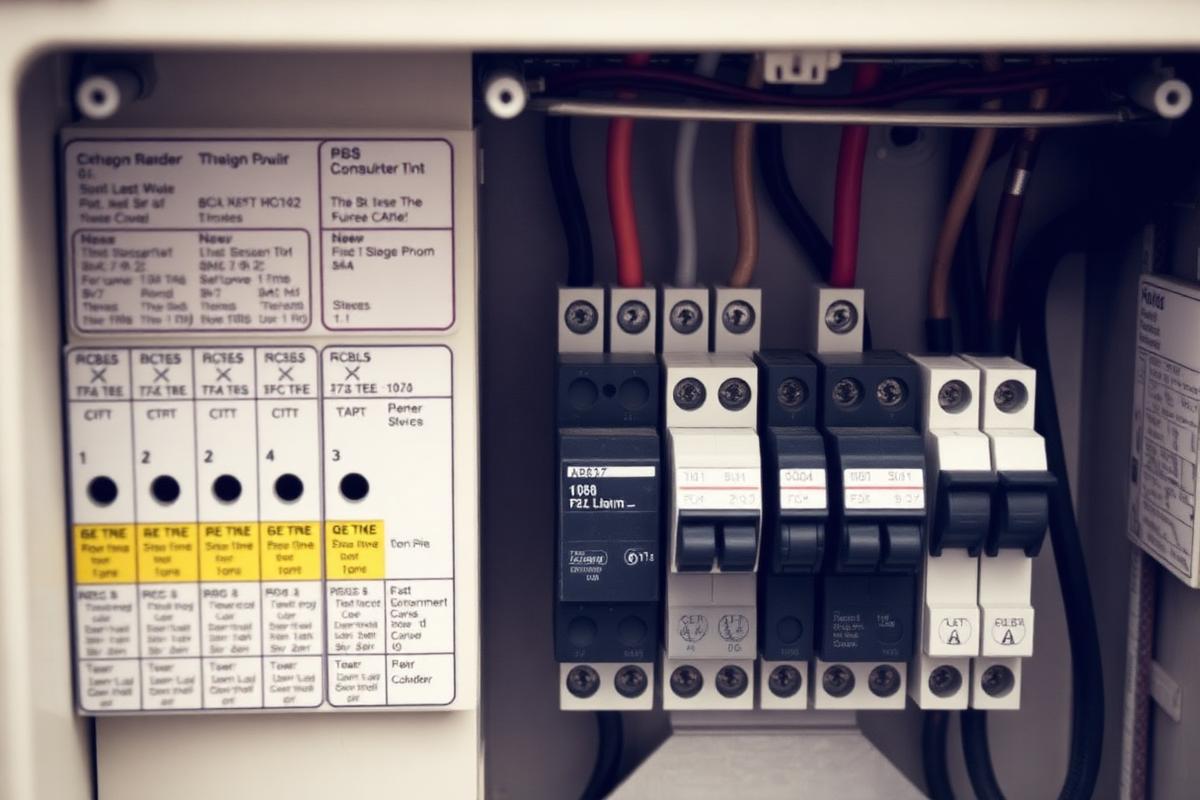
Every install begins at the meter, not the parking space. We check the main fuse rating, the earthing arrangement and how much spare capacity the property actually has once the shower, oven, hob and heat source are accounted for. This is the single biggest factor in whether a 7kW charger goes in as standard or needs extra work.
Older properties around Henley, Marlow and the Chilterns often have a 60A or 80A main fuse. That does not rule out a 7kW charger — it usually just means load management, which throttles the charger automatically when the rest of the house is drawing hard. A current transformer clamps around the incoming tails and the charger reduces its output rather than tripping the main fuse.
Earthing matters just as much. Most modern chargers include integrated open-PEN protection, which is what allows a PME (TN-C-S) supply to be used safely outdoors without a separate earth rod. Where a charger does not have it, or the property is on a TT supply, we install the appropriate earthing arrangement and record it on the certificate.
In short
- Main fuse rating and meter position
- Earthing arrangement (TN-S, TN-C-S/PME or TT)
- Consumer unit spare ways, RCD/RCBO protection and SPD
- Realistic maximum demand calculated to the current guidance
- Whether load management or a supply upgrade is the better answer
Cable route and charger position
The cable run drives most of the cost. A charger on the garage wall a couple of metres from the consumer unit is straightforward. One at the end of a 30-metre driveway needs a larger cable to keep volt drop inside limits, plus a trench or duct, reinstatement of the surface, and more time on site.
We agree the exact position at survey. The charger should reach your car's charge port on the side it actually parks, with the tethered cable stowed off the ground and the unit clear of doors, gates and bin storage. If you may change car, we plan for the port being on the other side.
Listed buildings and conservation areas — common across the Chilterns and the Thames valley — need a little more thought about surface routes and fixings. Discreet trunking, rear-of-building routes and colour-matched units usually solve it without any planning issue, since most domestic charge points are permitted development.
Untethered or tethered, and how many kilowatts
A tethered unit has the cable permanently attached — quicker day to day, tidier if you always charge the same car. An untethered socket takes any cable, suits households with two different vehicles and is easier to live with if you plan to change cars.
For power, 7kW single-phase is right for the overwhelming majority of homes. It adds roughly 25–30 miles of range per hour, which fully replenishes a typical daily commute several times over during an overnight window. 22kW needs a three-phase supply, which most Home Counties houses do not have, and many cars cannot accept more than 11kW AC anyway.
| Charger | Supply | Range added per hour | Typical use |
|---|---|---|---|
| 3.6kW | Single phase | ~12 miles | Constrained supplies, plug-in hybrids |
| 7kW | Single phase | ~25–30 miles | Standard home installation |
| 11kW | Three phase | ~40 miles | Homes with three-phase, larger EVs |
| 22kW | Three phase | ~80 miles | Workplaces, fleet, some rural properties |
Smart charging, tariffs and the regulations behind them
Every charge point sold for domestic use in Great Britain must meet the Electric Vehicles (Smart Charge Points) Regulations. In practice that means the unit is internet-connectable, defaults to charging outside peak hours, has randomised start delays, and keeps a secure record of your settings.
That regulation exists to make cheap overnight tariffs work. Moving charging to an EV tariff window is where the running-cost saving actually comes from: off-peak rates are typically a fraction of the day rate, so a full charge on a mid-sized EV can cost a couple of pounds rather than a tank of fuel. We set the schedule up with you at commissioning and show you how to change it.
If you already have solar, choose a charger with solar matching so surplus generation goes into the car rather than being exported at a lower rate. It is a specification decision, not something that can be bolted on later to every unit.
In short
- Set the charge window to your tariff's off-peak hours
- Enable solar surplus matching if you have PV
- Check the app supports scheduling per-vehicle if you run two EVs
- Confirm the unit gets firmware updates from the manufacturer

What it costs in 2026
A standard 7kW single-phase installation with a short cable run starts at £849 fitted, including the charge point, protective devices, testing, certification and app setup. That is a fixed price agreed after the survey — no hourly creep.
Where the price moves is almost always cable distance, groundworks, or the state of the existing consumer unit. We quote those items separately so you can see exactly what you are paying for and decide what is worth doing.
| Item | Guide cost | When it applies |
|---|---|---|
| Standard 7kW install | from £849 | Run up to ~10m, existing board suitable |
| Extra cable run | £15–£25 per metre | Longer surface or clipped runs |
| Trenching and duct | £60–£100 per metre | Driveway or lawn crossings |
| Consumer unit upgrade | £450–£850 | Rewireable fuses, no spare ways, no RCD |
| Load management kit | £120–£250 | 60A/80A supply with high existing demand |
| Three-phase 22kW unit | from £1,450 | Properties with an existing three-phase supply |
Get a fixed price for your charge point, including survey, certification and app setup.
Grants and who can still claim
Government support has narrowed over the years, but it has not gone. Renters and flat owner-occupiers with off-street parking can still claim under the EV chargepoint grant, and landlords can claim across multiple properties and rental units. There is also separate support towards cross-pavement solutions in some local authority areas.
Grants change; we check current eligibility for your specific situation at survey stage rather than promising a figure in advance. Claims must be made by an authorised installer, and the work has to be notified correctly for the claim to be valid.
Notification, certification and the day itself
Every charge point install is notified to the local distribution network operator — usually after the fact for a single 7kW unit, or in advance where the total demand warrants it. The work is certified to BS 7671 including Section 722, and notified under Part P where required.
On the day, expect three to five hours. We isolate the supply briefly, run and terminate the cable, fit the protective devices, mount and commission the unit, then test the whole circuit: continuity, insulation resistance, earth fault loop impedance, RCD/RDC-DD operation and polarity.
Before we leave you get the Electrical Installation Certificate, the commissioning record, the manufacturer registration for the warranty, and the app working on your phone with your tariff schedule already set.
In short
- Electrical Installation Certificate to BS 7671
- Building Regulations Part P notification where applicable
- DNO notification for the new load
- Manufacturer warranty registration (typically 3 years)
- App set up and off-peak schedule configured with you
How to compare quotes without getting caught out
Cheap quotes usually hide the same handful of omissions. Ask every installer the same questions and the differences become obvious quickly.
In short
- Is the price fixed after a survey, or an estimate subject to change?
- What cable length is included, and what is the rate beyond it?
- Is a consumer unit change included or excluded?
- Who notifies the DNO and issues the certificate?
- What happens if the supply turns out to need load management?
- Is the charge point OZEV-listed and smart-regulation compliant?
Common questions
- How long does an EV charger installation take?
- A typical home install is three to five hours. Longer cable runs, trenching or a consumer unit change can extend it to a full day.
- Do I need a three-phase supply?
- No. The vast majority of homes run a 7kW single-phase charger, which adds roughly 25 to 30 miles of range per hour — more than enough overnight.
- Can you install a charger without a driveway?
- Only where the cable can be managed safely on private land. Some councils now permit cross-pavement channels; we will tell you honestly at survey stage rather than fit something that trails across a pavement.
- Do I need planning permission for an EV charger?
- Almost never for a domestic wall-mounted unit — it is permitted development. Listed buildings and some conservation areas need the position agreed sensitively, which we handle at survey.
- Will an EV charger overload my supply?
- Not if the installation is designed properly. Where the existing maximum demand is high, load management reduces the charger's output automatically so the main fuse is never at risk.
- How much does it cost to charge an EV at home?
- On a dedicated off-peak EV tariff, a full charge on a mid-sized car typically costs a few pounds — far less than the same mileage on petrol. Charging at the standard day rate costs several times more, which is why the schedule matters.
Written by the Ridgeway team
The people who survey and install, in Henley-on-Thames